According to Wing Chun history, Moy Yat was one of the few disciples who actually completed the entire Wing Chun system under his Sifu, Grandmaster Ip Man. This DVD focuses on the Muk Yan Jong, or as it is more commonly known, the Wooden Dummy.
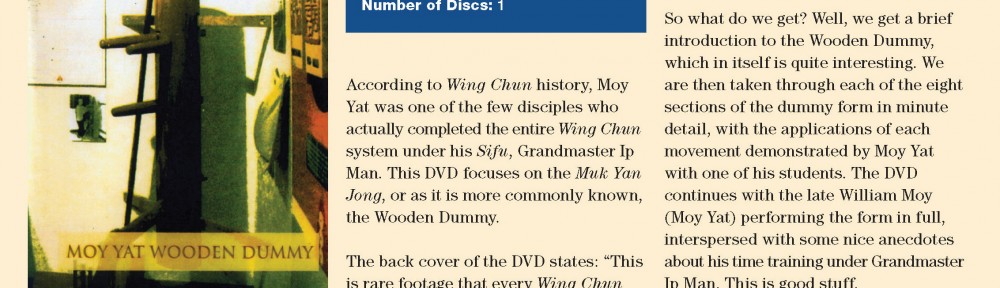
According to Wing Chun history, Moy Yat was one of the few disciples who actually completed the entire Wing Chun system under his Sifu, Grandmaster Ip Man. This DVD focuses on the Muk Yan Jong, or as it is more commonly known, the Wooden Dummy.
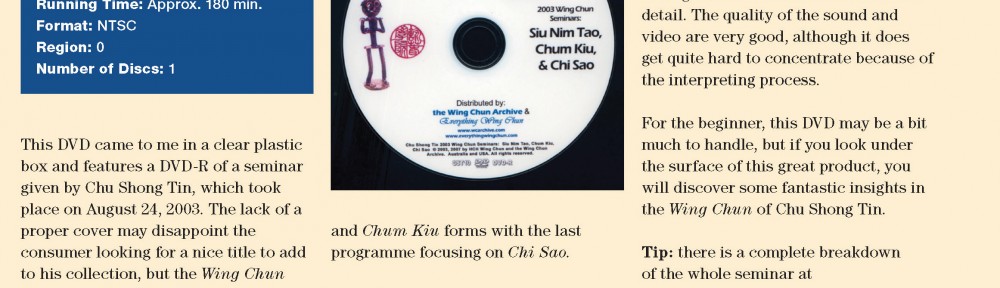
This DVD came to me in a clear plastic box and features a DVD-R of a seminar given by Chu Shong Tin, which took place on August 24, 2003. The lack of a proper cover may disappoint the consumer looking for a nice title to add to his collection, but the Wing Chun purist will be more than happy with what is actually on the disc itself. [EWC Admin Note: Since this was written the DVD started shipping in a full DVD case, so the comments about the plastic cases no longer hold true.] This title focuses on the Siu Nim Tao and Chum Kiu forms with the last programme focusing on Chi Sao.
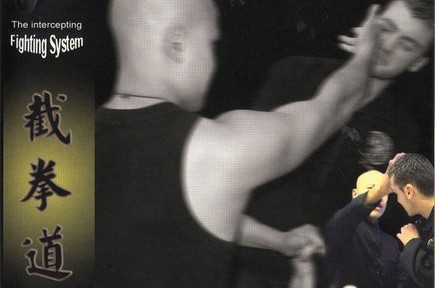
JKD Body Weapon Combat Zone (Energy Drills & Trapping)
Master Michael Wong is definitely one of the most unique and gifted instructors in the martial art world today. His hardcore personality and aggressive approach to teaching make his videos very exciting to watch. The first thing that you notice when watching Master Wong’s videos is that he is actually making contact with his students when he demonstrates the trapping techniques.
What it’s about:
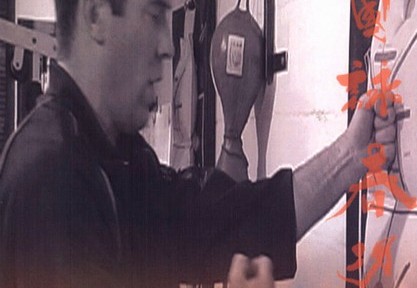
This DVD covers the essentials of Wing Chun Kung – Fu wall bag training, its associated warm up exercises and applications.
Comments:
Wing Chun as in many of the Chinese martial arts has training equipment unique in developing one’s power and skill in combative applications. Although most martial artists are aware of the Mook Jong or wooden dummy, used in training, perhaps many are unfamiliar with the three section wall bag in developing power. The first part of this DVD provides a great deal of time on the proper exercises or warm ups to prevent injury and damage to the internal organs, because of the acupuncture points associated with the fingers. So caution is given in preparing the hands and knowing how to strike the bag to minimize soft tissue damage. There are Chinese herbal preparations which are taken orally and herbs applied externally to the hands to promote the healing process. If you’re able to obtain the correct herbal preparation you actually could make the muscular of the hands far more lethal.
What it’s about:
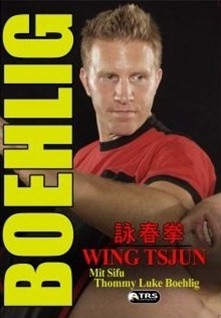
A three disc DVD set contained in one case providing instruction in the fundamentals of Wing Chun Kung-fu. Sifu Boehlig traces his Wing Chun Lineage through Leung Ting and Allen Fong.
Comments:
Boehlig starts his DVD with a short description of Wing Chun’s history and his lineage though Leung Ting and Allen Fong. He attributes his style of Kung Fu as a “Soft” style in which a person learns to use the principles of Wing Chun through softness, relaxation and flexibility to overcome a bigger and stronger opponent. Like other DVD’s of this genre, he approaches the basics of Wing Chun from the idea of ranges… that is, the distance which exist between yourself and the opponent. He talks about the distance where one does not engage the opponent and those distances which involve kicks and those that require punching. As well as the close range zone where you encounter an opponent and you use your knees, elbows and head if necessary.
VTM Wing Chun Series #10 Trapping Hands By Sifu Benny Meng
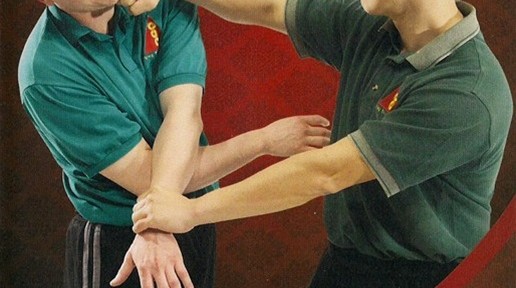
The first three videos of the VTM Wing Chun Series focused on the “Bread and Butter” of the Wing Chun Gung Fu system through the teachings of the Sil Nim Tao, Chum Kiu, and Biu Ji levels of training. In this last video of the series, Sifu Meng puts everything together based on the attributes and techniques learned from the previous DVDs. Trapping Hands is probably the most well know (and feared) aspects of the Wing Chun fighters arsenal, but Sifu Meng is quick to point out that trapping an opponent’s hands is not something you should look for during a fight.
VTM Wing Chun Series #9 Long Pole (Luk Dim Boon Kwan) By Sifu Benny Meng
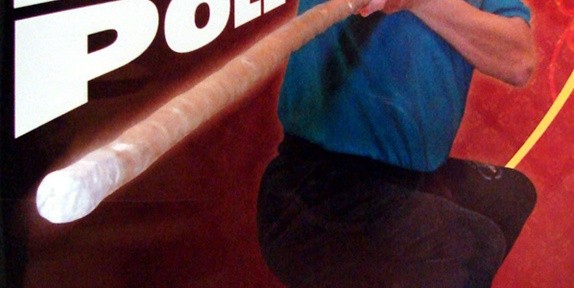
The Luk Dim Boon Kwan (Six and a Half Point Pole) is perhaps the most misunderstood forms in Wing Chun. I have seen many variations of this form and heard several explanations of the meaning behind the term “Six and a Half Point”. Now, not to say that anyone else is wrong, but Sifu Meng’s description of the six and a half concepts that comprise the long pole form makes the most sense to me. In section seven, Sifu Meng pulls up a chart that gives a detailed explanation of the seven main fighting concepts of which comprises the pole form; the seventh concept explains the half point that brings the other six concepts together in a continuous flow of movement. This is the reason behind the name given to the Long Pole form.