
VTM Wing Chun Series #9 Long Pole (Luk Dim Boon Kwan) By Sifu Benny Meng
The Luk Dim Boon Kwan (Six and a Half Point Pole) is perhaps the most misunderstood forms in Wing Chun. I have seen many variations of this form and heard several explanations of the meaning behind the term “Six and a Half Point”. Now, not to say that anyone else is wrong, but Sifu Meng’s description of the six and a half concepts that comprise the long pole form makes the most sense to me. In section seven, Sifu Meng pulls up a chart that gives a detailed explanation of the seven main fighting concepts of which comprises the pole form; the seventh concept explains the half point that brings the other six concepts together in a continuous flow of movement. This is the reason behind the name given to the Long Pole form.
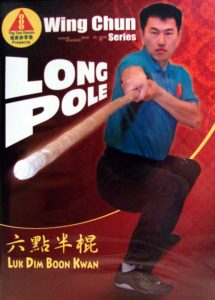 I could see how someone outside the system of Wing Chun could underestimate the effectiveness of the Long Pole form. The form is so short and simple, but like everything else in Wing Chun the underlining meaning and fighting concepts are remarkably effective. Sifu Meng points out in this video that the centerline concept of Wing Chun is crucial when fighting with the long pole, so much so that some Wing Chun historians believe that the Wing Chun’s centerline concept was derived from the long pole itself before being applied to the empty hand fighting system. The last section is a question and answer format where Sifu Meng ties the whole video together with a short history and review of the main fighting concepts. Although I was taught a slightly different variation of the Luk Dim Boon Kwan, seeing Sifu Meng demonstrate the long pole form helped me to see things from another angle and this helped me a lot with my own training. Like Sifu Meng says in his final statement, “We get our guidance from our teacher but one of the most important teachers is our own experience.” I think watching instructional videos from exceptional teachers like Sifu Benny Meng can be a very valuable part of the martial art learning experience.
Technical Review:
- DVD Length: 43 Minutes
- Display: NTSC
- Region: 0
- Type: DVD-R
- Language: English (No Subtitles)
- Video Quality: High (Professional Production)
- Audio Quality: High (Professional Production)
Content Review:
- Introduction
- Basic Exercises
- Horse Stance Punches
- Six Basic Single-Hand Pole Exercises
- Basic Two-Hand Pole Exercises
- Proper Hand Grip Position on the Long pole
- 3. Luk Dim Boon Kwan Form Demonstration by Sifu Benny Meng
- 4. Stances
- Neutral Stance
- Horse Stance
- Front Stance
- Back (Cat) Stance
- 5. Footwork
- Step and Slide Footwork
- Step Forward and Step Back
- Angling Left and Right
- 6. Techniques
- Downward Press
- Biu Kwan
- Lan Kwan
- Dan Kwan
- Til Kwan
- Tan Kwan
- Fook Kwan
- Bon Kwan
- Soo Kwan
- Concepts
- Sifu Benny Meng gives a very detailed explanation of the fighting concepts that are the main reason the Long Pole form is call the Luk Dim Boon Kwan (Six and a Half Point Pole).
- 1. Tip
- 2. Down
- 3. Up
- 4. Pry Open
- 5. Run
- 6. Obstruct
- 6 ½. Flow
- Sifu Benny Meng gives a very detailed explanation of the fighting concepts that are the main reason the Long Pole form is call the Luk Dim Boon Kwan (Six and a Half Point Pole).
- 7. Question & Answer
- Does the sequence of training matter for long pole practice?
- What is the history of the long pole?
- Why are there so many variations of the long pole form?
- 8. Conclusion: “We get our guidance from our teacher but one of the most important teachers is our own experience.”
Review by: Todd Taganashi
DVD Bought on: Everything Wing Chun
This DVD is also available for download on Everything Wing Chun Instant Access